What has been translated? What still needs work?
An evidence map for the Great Flood source list and MUL.APIN: available translations, manuscript losses and references still being identified.
The scope of this graph
The Great Flood thesis lists 21 labels, although its closing total says 20. This register preserves those 21 labels and adds MUL.APIN: 22 entries, not 22 proven independent ancient works. Nippur may overlap another listing. This is not a survey of all untranslated manuscripts in the world. English is the first access language being checked; French, German, Spanish and Hebrew need separate edition-level inventories.
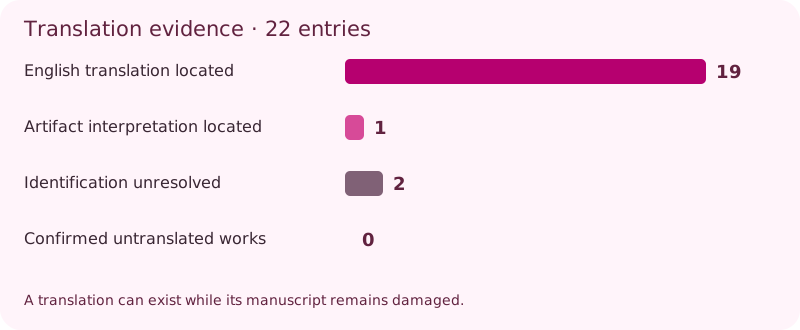
Untranslated, missing and inaccessible are different
Untranslated means a surviving text has no located translation after a documented search. Missing means the physical words have not survived or cannot currently be read. Inaccessible means an edition exists but we do not yet have lawful full-text access. Unidentified means a label does not yet point to an exact document. None of the identified works here has been verified as wholly untranslated. That finding cannot establish that every fragment or every reading has been translated.
Read the register
Open a source or publisher link for each entry. “Located” confirms an edition or reading route, not that its entire content has been acquired and reviewed. The source register records the narrower passages actually read.
1. Atrahasis
- Language and witness
- Akkadian
- What survives
- Fragmentary witnesses; editions reconstruct from multiple tablets.
- Translation or access route
- SOAS opening excerpt; SEAL Tablet I; Wasserman’s published Akkadian flood edition.
- Next step
- Use the relevant flood witness and line numbers before extending the opening study.
2. Enuma Elish
- Language and witness
- Akkadian
- What survives
- Seven-tablet composition; individual witnesses and passages can be damaged.
- Translation or access route
- L. W. King’s historical English translation is publicly readable.
- Next step
- Compare a current critical edition before relying on an old reconstruction.
3. Gilgamesh · Tablet XI
- Language and witness
- Akkadian
- What survives
- Flood narrative preserved through cuneiform witnesses; gaps remain edition-specific.
- Translation or access route
- Budge/Gadd’s 1929 English presentation is available. Selected passages reviewed.
- Next step
- Record the edition and exact passage; seek a current critical edition for detailed philology.
4. Nippur Tablet · title ambiguous
- Language and witness
- Sumerian or Akkadian; identification pending
- What survives
- At least two plausible candidates: CBS10673 (+ CBS10867), and CBS13532.
- Translation or access route
- Penn’s CBS10673 record identifies the Sumerian flood story; Wasserman edits Akkadian CBS13532 as Ms. J, pp. 77–79. Both have English translations.
- Next step
- Retain both candidates until the original reference is identified. Do not count this label as another independent work.
5. Sumerian King List · Weld-Blundell prism
- Language and witness
- Sumerian
- What survives
- AN1923.444 is a particular witness, not all surviving copies of the list.
- Translation or access route
- Ashmolean’s museum introduction supplies an English reading route and object identification.
- Next step
- Separate literary reign totals from independently established elapsed years.
6. Eridu Genesis / Sumerian Flood story
- Language and witness
- Sumerian
- What survives
- Extensive losses and difficult passages are explicitly marked in ETCSL 1.7.4.
- Translation or access route
- Oxford’s English translation is public and was reviewed.
- Next step
- Keep the gaps visible; compare the Nippur label before treating it as a separate source.
7. Genesis
- Language and witness
- Hebrew
- What survives
- A transmitted biblical book with multiple textual witnesses and editions.
- Translation or access route
- English chapters are public; Genesis 8 and 9 were reviewed for these studies.
- Next step
- Name the translation when comparing wording and distinguish textual study from a historical flood claim.
8. Book of Enoch · 1 Enoch
- Language and witness
- Ethiopic; Aramaic fragments and other witnesses
- What survives
- The Ethiopic tradition preserves the work more fully than the Qumran Aramaic fragments.
- Translation or access route
- R. H. Charles’s historical English edition is public.
- Next step
- Identify 1 Enoch explicitly; do not substitute it for 2 Enoch, 3 Enoch or the Book of Giants.
9. Book of Giants · including 4Q203
- Language and witness
- Aramaic Qumran fragments; other traditions distinct
- What survives
- Surviving Qumran fragments do not make a continuous complete book.
- Translation or access route
- Stuckenbruck’s 1997 Texts, Translation, and Commentary is published; full edition not yet obtained.
- Next step
- Request lawful access to the surviving texts, translation and apparatus; never fill losses as ancient testimony.
10. War Scroll · 1QM
- Language and witness
- Hebrew
- What survives
- A scroll with damaged portions; 1QM is not the same identifier as 4Q285 or 11Q War materials.
- Translation or access route
- Published English corpus editions include War Scroll material; the Vermes publisher record is located.
- Next step
- Obtain the exact edition and match 1QM columns. A digital viewer failure is an access issue.
11. Damascus Document · CD and Qumran witnesses
- Language and witness
- Hebrew
- What survives
- Cairo manuscripts and Qumran fragments must be distinguished.
- Translation or access route
- LOC introduces 4Q271 with a translation route. Wacholder’s The New Damascus Document is a published edition.
- Next step
- Acquire a whole-work edition; do not treat one fragment’s translation as all of CD.
12. Genesis Apocryphon · 1Q20
- Language and witness
- Aramaic
- What survives
- The surviving scroll is fragmentary.
- Translation or access route
- Machiela’s 2009 New Text and Translation is published; full edition not yet obtained.
- Next step
- Request the edition with its treatment of columns 13–17 and damaged readings.
13. Jubilees
- Language and witness
- Ethiopic; Hebrew fragments and other witnesses
- What survives
- The Ethiopic work and surviving Hebrew fragments have different coverage.
- Translation or access route
- Charles’s historical English translation is publicly readable.
- Next step
- Use a critical edition for manuscript comparisons; its website sections are not ancient chapter numbering.
14. Wisdom of Solomon
- Language and witness
- Greek
- What survives
- A transmitted book; biblical canon placement varies among traditions.
- Translation or access route
- English reading is public.
- Next step
- Identify the work and edition; do not label it a Qumran scroll without a manuscript reference.
15. Dendera Zodiac
- Language and witness
- Egyptian astronomical relief and inscriptions
- What survives
- A museum artifact, not a scroll or a single book awaiting translation.
- Translation or access route
- Louvre scholarship supplies interpretation and historical context.
- Next step
- Study the inscriptions and iconography by object reference; keep cosmological comparisons attributed.
16. Apocryphon / Secret Book of John
- Language and witness
- Coptic witnesses; Greek composition behind them
- What survives
- Long and short recensions require separate identification.
- Translation or access route
- Named English translations are available through the Nag Hammadi library index.
- Next step
- Select the recension and translator before aligning passages.
17. Gospel of Thomas
- Language and witness
- Coptic complete collection; Greek fragments
- What survives
- Coptic sayings and Greek fragments are different witnesses.
- Translation or access route
- Named English translations are publicly readable.
- Next step
- Match saying numbers and the chosen witness; do not call a companion lesson an audio transcript.
18. Corpus Hermeticum
- Language and witness
- Greek; Latin Asclepius in the named edition
- What survives
- A collection of treatises, not interchangeable with the Emerald Tablet.
- Translation or access route
- Copenhaver’s Hermetica is a published English edition; publisher record located.
- Next step
- Obtain the chosen edition for exact treatise-level study; keep the Emerald Tablet separate.
19. Qur’an · Surah Nuh (71)
- Language and witness
- Arabic
- What survives
- A named surah within a transmitted scripture.
- Translation or access route
- Arabic text and English translations are publicly readable.
- Next step
- Name the translator and verse; do not silently import a passage from another surah.
20. Matsya Purana
- Language and witness
- Sanskrit
- What survives
- A later Purāṇic work; distinct from the Vedic Śatapatha Brāhmaṇa fish narrative.
- Translation or access route
- UPenn’s library catalogue identifies the 1916–17 English Matsya Puranam, translated by “A Taluqdar of Oudh,” in two volumes. Full volumes not reviewed.
- Next step
- Use the catalogue’s holding links; confirm regional access and the flood chapter before quoting.
21. Vatican Archives (Filtered) · unidentified reference
- Language and witness
- Not established
- What survives
- No document title, fonds, shelfmark or original correspondence has been identified.
- Translation or access route
- Official Archive contact and Vatican Library digital catalogues are located. These are different institutions.
- Next step
- Request bibliographical guidance. There is no verified document supporting the source list’s 2026 Venus-tracking claim.
22. MUL.APIN · The Plough
- Language and witness
- Akkadian
- What survives
- An astronomical compendium preserved in cuneiform manuscripts.
- Translation or access route
- Hunger and Steele’s 2019 edition contains English translation, transliteration and commentary. Full edition not yet obtained.
- Next step
- Request lawful full-text access before publishing line-level conclusions.
Keep the learning open
The Father and Yeshua remain Babylon’s devotional centre. Every learner is sovereign. A source can deepen a question without becoming a claim of authority over another person. Our next step is to obtain specific editions, preserve their uncertainties and make useful learning accessible without guilt or shame.
Learning in the Light
In Babylon, the Father’s light opens perspective, learning and a chosen next step. Your worth remains intact. Every person is sovereign, with dignity, freedom and room to grow.
Read the learning principle ↗Older documents: the factual register
See translation availability, located passages, manuscript limits and the work that needs doing next.
Older documents: the factual register ↗Follow the translation evidence
Find the existing registers, review limits and actions still needed. Translation availability, public access and completed review are separate questions.
Follow the translation evidence ↗